INDUSTRY HISTORY · 17 MIN READ
Purplebricks Australia: what happened, and why the idea outlived it
It launched in 2016 with a fixed fee and left in 2019. We mapped 5,610 of its Australian listings to see how far the idea got, and why the business didn’t last.

What happened to Purplebricks in Australia?
Purplebricks launched in Australia in August 2016 with a $4,500 fixed fee instead of a percentage commission. Thousands of sellers used it. In May 2019 the company announced it would leave Australia, citing “increasingly challenging” market conditions and “execution errors”. Fast expansion, expensive advertising, a fee model that drew a regulator’s attention and a falling property market all played a part. The business closed. The idea behind it, selling a home for a fixed fee, did not.
| Australian launch | 28 August 2016 |
| Launch markets | Melbourne and Brisbane, then Sydney, Perth and Adelaide |
| Original fee | $4,500 fixed |
| Exit announced | 7 May 2019 |
| Business model | Hybrid agency: licensed agents, online platform, fixed fee |
| Listings identified in our research | 5,610 |
| Largest state footprint | Queensland (2,004 listings) |
Key takeaways
- Purplebricks charged a fixed fee when almost every Australian agent charged a percentage.
- Our research identified 5,610 Australian properties listed through Purplebricks, across five states.
- Queensland made up more than a third of them. The biggest clusters sat in outer-suburban growth areas, not inner-city suburbs.
- Purplebricks itself blamed market conditions and execution errors. Its chairman said it expanded too fast.
- The tools and buyer habits that make a fixed-fee model cheaper to run have changed a lot since 2016.
Purplebricks was supposed to change Australian real estate
In 2016, if you sold a house in Australia, you paid your agent a percentage of the sale price. That was the deal. Nobody asked why.
Purplebricks asked. When it launched here in August 2016, it said Australian sellers were paying an average 2.2% commission plus about $2,500 in marketing. It offered a $4,500 fixed fee instead. That fee covered professional photos and listings on realestate.com.au and Domain. Purplebricks worked out that, on the median Australian house price at the time, a seller would save about $11,500.
That pitch landed because the maths is easy. A 2.2% commission on a $700,000 house is $15,400. On a $1.2 million house it’s $26,400. The agent does roughly the same work for both. The fee goes up because the house is worth more, and for most sellers that was the first time anyone had pointed it out on TV.
I’ve worked in real estate for more than 15 years and conducted over 2,000 auctions. Very few people inside the industry wanted that question asked out loud. Purplebricks asked it on prime-time television.
What was Purplebricks?
Purplebricks started in the UK in 2014. It grew fast there and listed on the London Stock Exchange. Australia was its first market outside Britain, and it later launched in the US and Canada.
You’ll often see Purplebricks lumped in with DIY "sell it yourself" websites. That’s wrong. Purplebricks was a hybrid agency. The Australian model combined:
- Licensed agents. Purplebricks called them Local Property Experts. They valued homes, advised sellers and could run open homes.
- An online platform. Sellers tracked enquiries, viewings and offers in an app.
- Portal advertising. Every listing went on realestate.com.au and Domain.
- A fixed price. One fee, set before the campaign started.
- Fewer offices. No shopfront in every suburb, which cut overheads.
Auctions cost extra. At launch, Purplebricks charged an $825 top-up for an auctioneer and agent-run viewings.
That mix matters later in this story. Purplebricks never argued that you don’t need a professional. It argued that a professional’s fee shouldn’t grow with your house price.
Did Australians actually use Purplebricks?
Yes. A lot more than most people remember.
We identified 5,610 Purplebricks listings across Australia
We built a dataset of Australian properties listed through Purplebricks between 2016 and 2019. It contains 5,610 listings.
About the dataThese are listings. We can’t confirm a sale for every record, so I’m not claiming Purplebricks sold 5,610 homes. What the data does show is that more than 5,600 Australian sellers chose a fixed-fee agency and put their home on the market with it.
Purplebricks’ own reporting backs up the scale. In December 2017 the company said it had sold about 2,200 Australian homes in its first 14 months, worth a combined $1.1 billion. It had 1,348 properties on the market and 105 agents at the time.
That’s a real business. Inner-city early adopters alone don’t produce numbers like that.
Where did Purplebricks work best?
Queensland stands out first. It had more Purplebricks listings than Victoria, even though Melbourne is a bigger market than Brisbane. Western Australia is the other surprise. Perth produced almost as many listings as the whole of New South Wales.
The postcode data tells you more.
Queensland
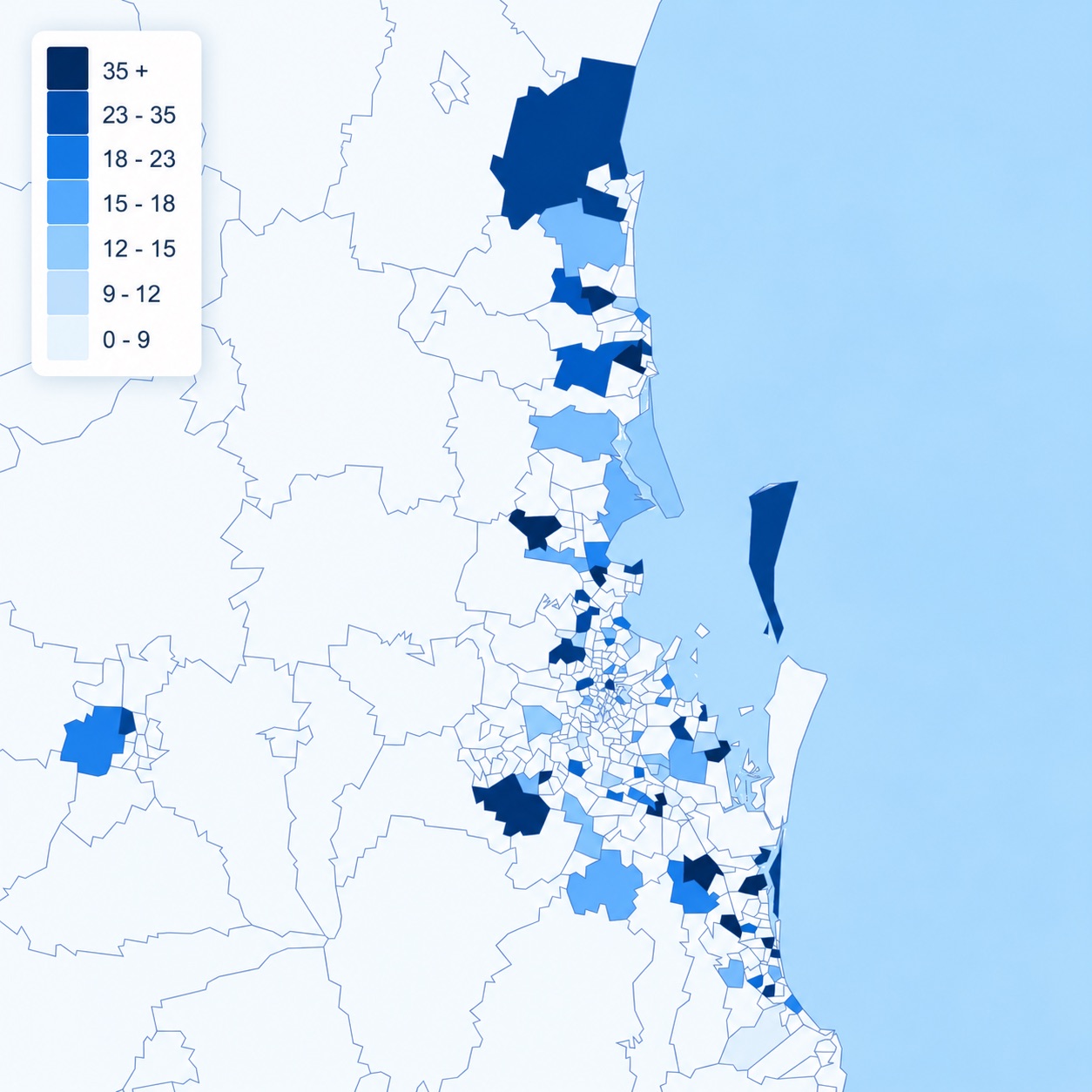
The darkest postcodes form a ring around Brisbane rather than sitting in it. Caloundra on the Sunshine Coast, Caboolture to the north, Springfield to the south-west, Logan and the northern Gold Coast all show up strongly. Most inner-Brisbane postcodes stay pale.
| Postcode | Area | Listings |
|---|---|---|
| 4551 | Caloundra and surrounds | 59 |
| 4215 | Southport | 53 |
| 4209 | Coomera, Upper Coomera, Pimpama | 48 |
| 4207 | Beenleigh, Eagleby and surrounds | 47 |
| 4300 | Springfield, Goodna, Augustine Heights | 46 |
| 4510 | Caboolture, Morayfield | 44 |
| 4211 | Nerang, Pacific Pines, Highland Park | 42 |
Victoria
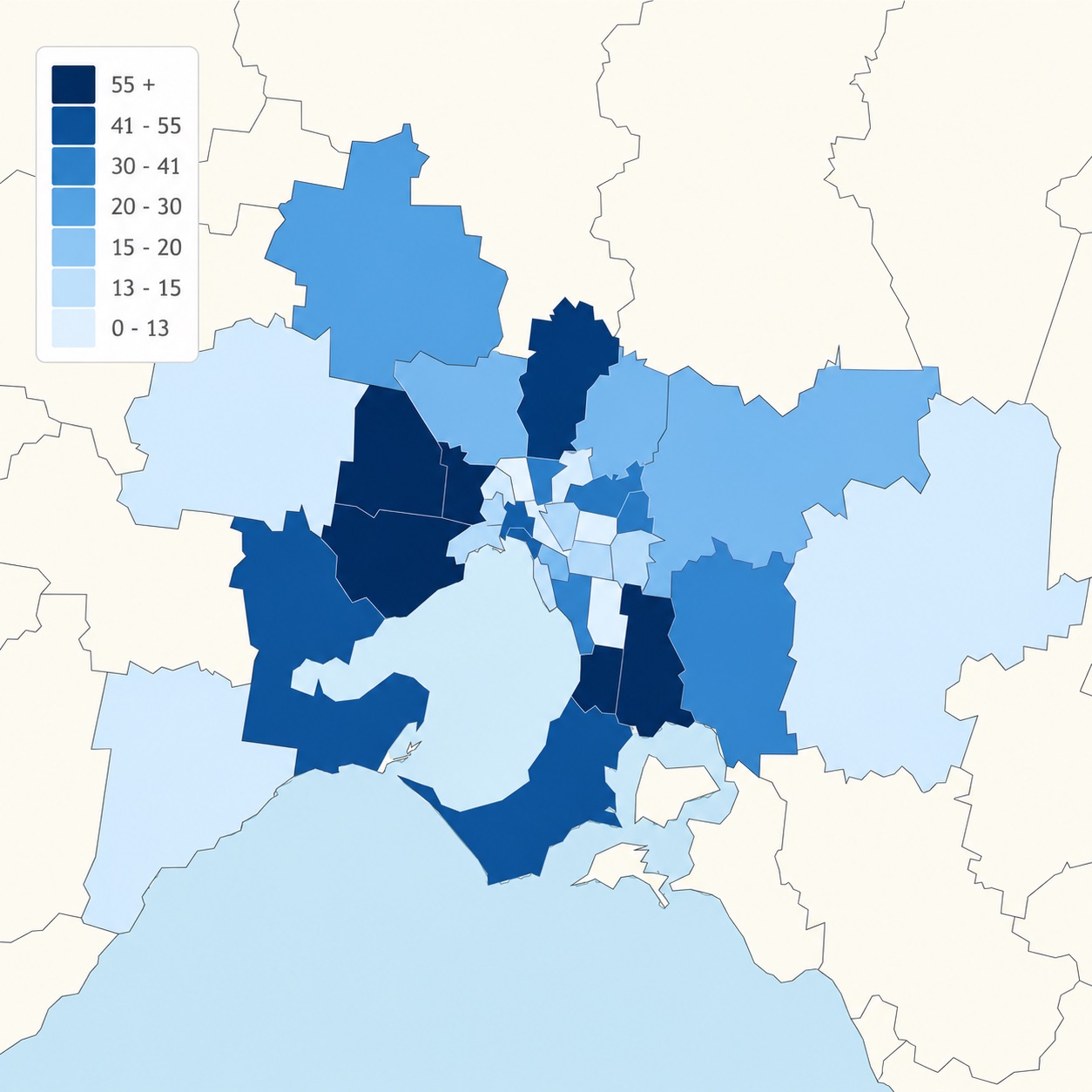
Melbourne shows the same pattern at council level. The heaviest use came from the outer west, around Werribee, Point Cook and Tarneit, and the outer south-east, around Cranbourne. Geelong and the Mornington Peninsula also show strong numbers. The inner-city councils are among the palest on the map.
| Postcode | Area | Listings |
|---|---|---|
| 3977 | Cranbourne and surrounds | 54 |
| 3030 | Werribee, Point Cook | 43 |
| 3029 | Hoppers Crossing, Tarneit, Truganina | 32 |
| 3064 | Craigieburn, Roxburgh Park | 29 |
| 3028 | Altona Meadows, Laverton, Seabrook | 25 |
| 3136 | Croydon | 20 |
| 3810 | Pakenham | 20 |
New South Wales
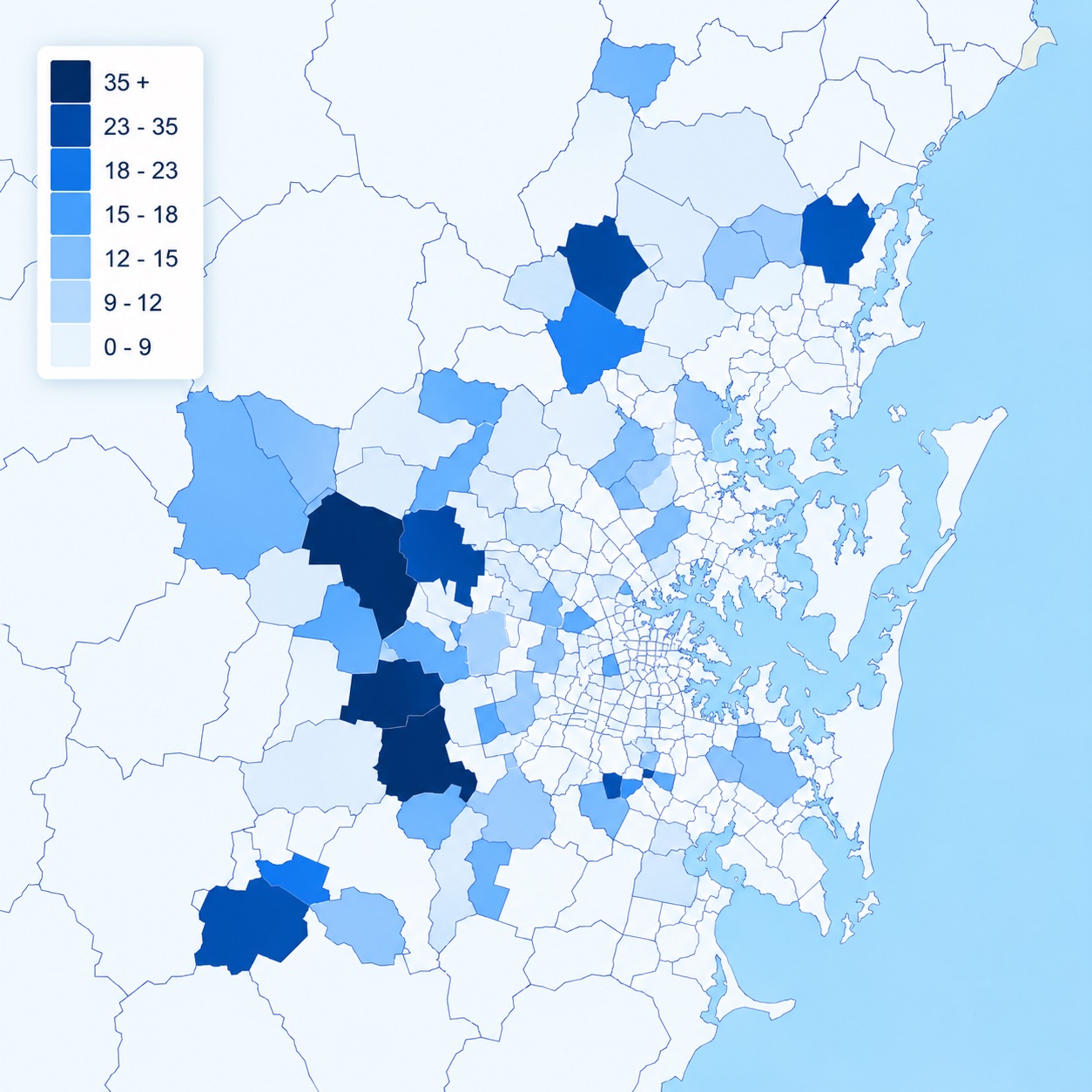
Sydney follows the same pattern. The darkest postcodes sit in the outer west and south-west, around Penrith, St Marys and Mount Druitt. The inner city, the eastern suburbs and the North Shore barely register.
| Postcode | Area | Listings |
|---|---|---|
| 2747 | Kingswood, Werrington, Jordan Springs | 19 |
| 2259 | Wyong, Tuggerah, Hamlyn Terrace | 18 |
| 2148 | Blacktown, Kings Langley | 17 |
| 2250 | Gosford, Erina | 17 |
| 2770 | Mount Druitt, Minchinbury | 16 |
| 2760 | St Marys, Colyton | 15 |
| 2570 | Camden, Narellan, Oran Park | 14 |
What did these areas have in common?
Look at the list and a pattern shows up. South-East Queensland’s Sunshine Coast, Gold Coast and Logan-Ipswich corridors. Melbourne’s western and south-eastern growth suburbs. Western Sydney and the Central Coast.
I’d be careful about claiming exactly why these places adopted Purplebricks. The data shows where, not why. But the hotspots share a few things you can check:
- Mostly detached houses. Most of these postcodes are dominated by family homes on their own land.
- Prices around or below the state median. In May 2017, analyst Mike DelPrete reported Purplebricks’ median sale price as $493,000 in Queensland and $530,000 in Victoria, both below the median home value in each state.
- Newer estates with similar homes. When the house next door is a similar build on a similar block, sellers can see what it sold for. Pricing feels less like guesswork.
- Owner-occupiers. These are suburbs where families buy, live and sell. They’re spending their own money on the fee.
That second point surprises people. If the saving on a fixed fee is biggest for expensive homes, why did Purplebricks do best in mid-priced suburbs? One explanation is that a $10,000 saving matters more to a family selling a $500,000 house than $25,000 does to someone selling for $1.5 million. Another is that sellers in these areas had less loyalty to a local agency brand. Our data can’t settle that yet. It does show that fixed-fee selling found its first big audience among ordinary families in the suburbs, not among a handful of tech-savvy inner-city sellers.
So why did Purplebricks leave Australia?
On 7 May 2019, Purplebricks announced it would wind down its Australian business. It gave two reasons: market conditions had become "increasingly challenging", and the company had made "some execution errors". It said the likely returns in Australia were not enough to justify continued investment.
The same day, founder and CEO Michael Bruce stepped down. Chairman Paul Pindar told shareholders:
With hindsight, our rate of geographic expansion was too rapid and as a result the quality of execution has suffered.
Paul Pindar, Chairman, Purplebricks Group, May 2019
No single factor killed Purplebricks Australia. Seven of them stacked on top of each other.
Factor 1: It expanded too fast
Purplebricks opened in Melbourne and Brisbane in August 2016. It planned to reach Sydney, Perth and Adelaide within the same year. By late 2017 it had 105 agents across five states.
At the same time, it was launching in the US. That’s three countries, three sets of property laws and three very different selling cultures inside about two years.
Pindar’s own words describe an execution problem. Nothing in them says Australian sellers rejected fixed fees.
Factor 2: Winning customers cost a fortune
Purplebricks said it would invest £10 million, about A$17 million, in its Australian business over its first two years. Much of that went on mass advertising, especially television. Reporting in 2017 described heavy spending on channels like 7mate and 9Gem.
Here’s the problem with that. Most people sell a home once every eight to ten years. A TV ad reaches millions of people, and almost none of them are selling this month. Someone might see your ad in March and not list until the following year. By then they’ve forgotten your name.
That kind of advertising works when you have a huge budget and a lot of patience. Purplebricks had the budget for a while. Shareholders ran out of patience.
Today a fixed-fee business can find sellers in a far cheaper way. A homeowner searches "how much is my house worth" or "real estate agent fees". They read an article. They try a valuation tool. They get follow-up when they’re ready, not when a TV schedule says so. Most of those tools existed in 2016, but they were nowhere near as cheap, accurate or connected as they are now.
Factor 3: It arrived early in Australia’s digital habits
Australians were online in 2016. That’s not the point. Purplebricks was asking people to trust a largely digital process with the biggest sale of their lives.
In 2016 most Australians had never been on a video call for work. Most had never signed a major contract on a screen. Online banking was normal; running a property sale through an app was not.
COVID changed that in 2020. Video inspections, electronic signing and remote settlements became normal in about six months. Purplebricks was gone by then.
Factor 4: The technology wasn’t where it is today
In 2016 Purplebricks could offer you an online listing, an agent and a fixed fee. That was the whole toolkit.
Here’s what a fixed-fee business can run on in 2026:
- Automated valuations built on comparable sales data
- Instant replies to buyer enquiries, day and night
- Digital offers and electronic contracts
- A CRM (customer database) that follows up every buyer automatically
- Data on which buyers are serious, based on what they look at and click
- Online identity checks
- Campaign dashboards sellers can see in real time
- Targeted digital advertising aimed at people likely to sell soon
Each of those removes hours of manual work. I’ve written separately about how much of the agent’s job these tools have taken over since 2015. Fewer hours per sale means a fixed fee can cover the work and still leave a margin. Purplebricks had to do most of that work by hand, which made the economics much harder.
Factor 5: The Australian offer had real problems
I won’t sanitise this part. Purplebricks’ early Australian fee was payable whether or not your home sold. If you cancelled, you could still owe it. Some services, like auctions, cost extra.
That created a gap between the headline ("one low fixed fee") and what some customers experienced. Australian sellers are used to paying commission only when the house sells. Asking them to pay regardless was a big change, and some felt they hadn’t understood it.
Industry voices made a related point. In September 2019, REA Group’s Steve Carroll said Purplebricks’ "save money" message didn’t resonate with Australians, and that its model didn’t fit the auction culture of Sydney and Melbourne.
Purplebricks did change. In October 2018 it moved to a model where sellers paid the fee only on sale. By then the business had less than a year left.
Factor 6: The Queensland regulatory problems
In March 2018, Purplebricks entered two enforceable undertakings with Queensland’s Office of Fair Trading. These related to alleged breaches of the Australian Consumer Law and the Property Occupations Act.
The Office of Fair Trading had received complaints that Purplebricks’ website and advertising didn’t make clear that its fees were payable even if a property didn’t sell, or if the seller cancelled. The issue covered agreements signed between November 2016 and June 2017. Purplebricks paid a $20,000 penalty and agreed to change its forms, processes and website information. The undertakings ran for three years.
To be fair to Purplebricks, it fixed the issues the regulator raised. (Queensland’s disclosure rules for sellers have changed since; see our guide to selling a house privately in Queensland.) A $20,000 penalty didn’t close an Australian business. But in Queensland, its biggest state, the story of a low-fee agency in trouble with Fair Trading did real damage to trust at the exact moment it needed sellers to take a chance on it.
Factor 7: The property market turned
Purplebricks launched into a boom and left in a slump.
CoreLogic data shows national home values fell 8.4% between October 2017 and June 2019. Sydney fell 14.9% from its peak. Melbourne fell 11.1%. Purplebricks announced its exit in May 2019, right at the bottom of that fall.
A falling market hurts a fixed-fee agency in a specific way. Homes take longer to sell. More campaigns end without a sale. Sellers pull their homes off the market. Under the original Purplebricks model, sellers paid up front and carried that risk. Under the later pay-on-sale model, Purplebricks carried it. Both are hard to sustain when listings sit for months.
The idea vs the execution
| The idea | The execution |
|---|---|
| A fixed fee | Rapid expansion across five states and the US |
| Lower costs for sellers | Heavy spending on TV advertising |
| Technology-led selling | Technology still early |
| Challenge commission | An offer that didn’t fit Australian expectations |
| More choice for sellers | Fee terms that drew a regulator’s attention |
What Purplebricks got right
It’s easy to write Purplebricks off as a failure. That misses what it did.
Purplebricks challenged one of Australian real estate’s oldest assumptions: that selling a more valuable home should automatically mean paying a bigger fee. (I’ve looked at why that commission model still exists in more detail.) Before 2016, most sellers had never heard a serious alternative. After Purplebricks, fixed-fee selling was something you could ask your neighbour about.
It also:
- Got fixed fees into mainstream conversation through national TV
- Made sellers ask agents to justify their commission
- Put technology into the selling process years before COVID forced the rest of the industry to catch up
- Showed that thousands of Australians would try something different with their biggest asset
Go back to the map. 5,610 listings across five states. Clusters in Caloundra, Cranbourne and Kingswood. Those were real families choosing a fixed fee.
The company failed. The problem it set out to solve is still here.
Was Purplebricks wrong, or was it early?
Put 2016 next to 2026 and the gap is obvious.
| 2016 | 2026 |
|---|---|
| Pre-COVID habits | Sellers comfortable doing big things online |
| Heavy TV advertising to find sellers | Targeted digital advertising and search |
| Basic online workflows | Connected platforms from valuation to settlement |
| Limited automation | AI and automation across the campaign |
| Manual follow-up | Automatic follow-up with every buyer |
| Digital contracts unusual | Digital contracts normal |
| Fixed fees unfamiliar | Most sellers have heard of an alternative to commission |
Every row on the right makes a fixed fee cheaper to deliver than it was in 2016. Nearly a decade on, the useful question about Purplebricks is whether the model was wrong or just early.
What would Purplebricks look like if it launched today?
Strip away the brand and ask what a fixed-fee agency needs in 2026 to avoid Purplebricks’ mistakes.
It needs licensed professionals, because selling a home involves legal obligations and high-stakes negotiation. It needs a price you can read in one line, with every inclusion listed up front. It needs to pay a low price for each customer it wins, which means search and digital advertising rather than prime-time TV. It needs technology doing the repetitive work: valuations, enquiry replies, buyer follow-up, contract paperwork. And it needs people stepping in where judgement matters, like setting a price and negotiating an offer.
That’s close to what the next generation of fixed-fee property businesses is building now.
From Purplebricks to Unreserved Plus
I built Unreserved around the same principle Purplebricks challenged: professional real estate service shouldn’t require handing over 2% to 3% of your home’s value.
Unreserved Plus doesn’t copy the Purplebricks operating model. It’s built for 2026. You open the door for inspections. You know your home better than anyone, and buyers like hearing from the owner. A licensed campaign manager handles the rest:
- Listing on realestate.com.au, Domain and other major portals
- Writing and building the listing
- Every buyer enquiry, and follow-up with each buyer
- Pricing strategy, built on comparable sales data
- Running the campaign, including an auction if you choose one
- Negotiating your offers
- Licensed agent support all the way to settlement
Photography, signboards and brochures are optional extras, priced separately.
The fee is $6,900, fixed: $2,000 upfront and $4,900 when your home sells. No commission, whatever the sale price. There’s no lock-in contract. I’m spelling out the split on purpose. Purplebricks got into trouble when sellers didn’t understand when they had to pay, so you should know before you start.
On a $900,000 sale, a 2.1% commission is $18,900. On a $1.5 million sale it’s $31,500. The Plus fee stays $6,900 either way. When we sold 377 Barkly Street in Elwood for $1,550,000, the owner paid $6,900. A 2.1% commission would have been $32,550. You can run your own numbers in the savings calculator.
We’re licensed in the same five states Purplebricks operated in: Queensland, Victoria, New South Wales, Western Australia and South Australia.
What’s changed is everything around the model
| Purplebricks Australia | Unreserved Plus | |
|---|---|---|
| Years | 2016 to 2019 | 2026 |
| Pricing | Fixed fee | Fixed fee |
| Model | Hybrid agency | Licensed, technology-led service |
| Finding sellers | Heavy TV and above-the-line advertising | Search and targeted digital advertising |
| Buyer habits | Pre-COVID | Post-COVID |
| Technology | Before generative AI | AI valuations, automated enquiry handling and follow-up |
| When you pay | Originally the full fee, sale or not; pay-on-sale from October 2018 | $2,000 upfront, $4,900 on sale |
| Fee clarity | Fee terms drew a regulator’s attention | Inclusions and payment split listed before you sign |
| The seller’s question | Why am I paying a percentage? | Same question |
I’m not putting this table here to score points. Purplebricks helped establish the idea. The world around that idea has moved on.
Purplebricks failed. Its question didn’t.
Purplebricks left Australia in 2019. Nobody disputes that.
But if you sum up the story as "Australians didn’t want fixed-fee real estate", you ignore what happened. More than 5,600 Australian properties went to market through Purplebricks. It built a national footprint in under three years and forced the industry to defend a pricing model that had gone unquestioned for decades.
Its execution had problems. Its expansion was expensive. Its timing ran straight into a downturn. And the technology to run the model cheaply wasn’t ready.
Purplebricks may not have been the final version of fixed-fee real estate. It may have been the first serious attempt at what comes next.
Thinking about selling?
See what a fixed fee looks like next to a percentage commission on your home. Start with a free AI valuation built on real comparable sales.
Get a free AI valuationQuestions people ask
What was Purplebricks?
Purplebricks was a UK-founded hybrid real estate agency. It combined licensed agents with an online platform and charged sellers a fixed fee instead of a percentage commission. It operated in Australia from 2016 to 2019.
What happened to Purplebricks Australia?
Purplebricks announced on 7 May 2019 that it would wind down its Australian business. It cited “increasingly challenging” market conditions and “execution errors”, and said future returns didn’t justify further investment.
Why did Purplebricks fail in Australia?
Several factors combined: very fast expansion across five states and the US, expensive TV-led advertising, a fee that was originally payable whether or not a home sold, enforceable undertakings with Queensland’s Office of Fair Trading, and a national housing downturn from late 2017 to mid-2019.
When did Purplebricks leave Australia?
Purplebricks announced its exit on 7 May 2019 and began an orderly wind-down of the business from that date.
How much did Purplebricks charge?
Purplebricks launched in Australia with a $4,500 fixed fee, including photography and listings on realestate.com.au and Domain. Auctions cost an extra $825. By late 2017 its average fee had risen to $5,282.
Was Purplebricks a real estate agency?
Yes. Purplebricks was a licensed real estate agency. Its agents, called Local Property Experts, appraised homes and advised sellers. It was not a DIY listing website.
Did Purplebricks sell houses in Australia?
Yes. Purplebricks reported selling about 2,200 Australian homes worth $1.1 billion in its first 14 months of trading.
How many properties did Purplebricks list in Australia?
Our research identified 5,610 Australian properties listed through Purplebricks: 2,004 in Queensland, 1,301 in Victoria, 1,029 in New South Wales, 1,001 in Western Australia and 275 in South Australia.
Did Purplebricks charge commission?
No. Purplebricks charged a fixed fee rather than a percentage of the sale price. That was the core of its offer.
What was wrong with the Purplebricks model?
The biggest criticism was that the original fee was payable even if the home didn’t sell or the seller cancelled. Queensland’s Office of Fair Trading found some customers hadn’t been told this clearly. Purplebricks changed to a pay-on-sale model in October 2018.
Are there alternatives to Purplebricks in Australia?
Yes. Several Australian businesses now offer fixed-fee selling, from self-managed listing services to fully supported fixed-fee agencies. Unreserved offers both: Unreserved Lite at $900, where you run the sale, and Unreserved Plus at $6,900, where a licensed campaign manager runs it.
Can you still sell your home for a fixed fee in Australia?
Yes. You can sell for a fixed fee in every state. Unreserved is licensed in Queensland, Victoria, New South Wales, Western Australia and South Australia.
Is Unreserved similar to Purplebricks?
Unreserved shares the same principle: your agent’s fee shouldn’t depend on your home’s price. The model is different. Unreserved Plus costs $6,900 fixed ($2,000 upfront, $4,900 on sale), you open the door for inspections, and a licensed campaign manager handles listing, buyer enquiries, pricing, negotiation and support through to settlement.
Related reading: Real estate agent commission in Australia · How to sell your home without paying commission · The process of selling a house · What to know before selling your house · Three homes, three states, no commission · Compare your selling options
Sources: Purplebricks Group plc, “Launch of business in Australia” (Aug 2016) and trading update (7 May 2019); Apartments.com.au / Property Observer (Dec 2017); Mike DelPrete (May 2017); SmartCompany (Mar 2018, May 2019); The Negotiator (Sept 2019); CoreLogic Home Value Index.
General information only. This article is a history of Purplebricks in Australia, drawn from the company’s own announcements, contemporary reporting and Unreserved’s research. Listing counts are identified listings, not confirmed sales. It is not legal or financial advice. Unreserved Real Estate is a licensed agency.
ABOUT THE AUTHOR
Ben Williams
Connect with Ben on LinkedIn →
Ben spent 15+ years as a licensed estate agent and conducted over 2,000 auctions before founding Unreserved. He holds a Bachelor of Applied Science (Property & Valuation) from RMIT and is licensed across VIC, NSW, QLD, SA, and WA.